
 English



Parameters and Calculation Formulas for Common Mode Choke
What’s about Common Mode Choke
Common modechoketypically consist of a magnetic core and two sets of winding. Visually, they appear as two sets of copper wires wound around a ring core, and they also come in different structural designs such as UU-type, and chip-type. Common-modechoke are usually connected in series on the L line and N line of the power supply. Their main function is to allow normal operating current to pass through while suppressing common-mode high-frequency interference.
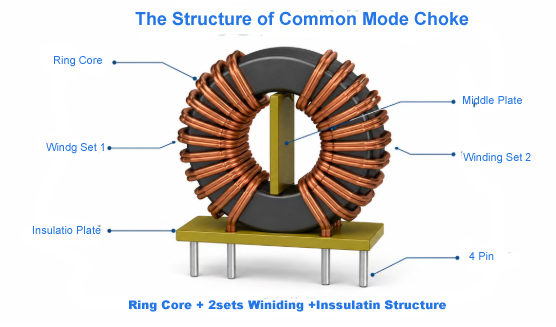
Figure 1 | Schematic of the appearance structure of a common-mode inductor
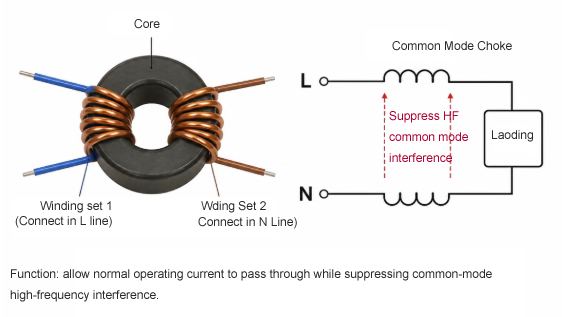
Figure 2 | Schematic of common-mode inductor connected in series on the L/N line
For Example: What’s 6.8mH meaning?
mH Is it the unit of inductance?. for example: L=6.8mH
|
Unit |
Name |
Description |
|
L |
Inductance |
The magnitude of inductance |
|
H |
Henry |
The basic unit of inductance |
|
mH |
Millihenry |
Millihenry = 1/1000 Henry |
Conversion relationship: 1H = 1000mH. When engineers say 'this common-mode inductor is 6.8mH', they are typically referring to the common-mode inductance value of the component. Inductance is one of the important parameters that describe this common-mode inductor.
For Example: What’s 1A, 2A refer to?
It’s rated current, take 6.8mH/2A for example.
6.8mH : Inductance 2A: Allowable working current related indicators
The larger the current, the higher the requirements are typically for the copper wire gauge, DCR (Direct Current Resistance), and temperature rise. Therefore, you cannot simply say, 'I need a 6.8 mH inductor.' You also need to know: what actual current will flow through it.
What’s AL Value?
Take“AL=5000nH/N2” for example, we can treat it like: Request wind how many pcs to received how much inductance value?
Common Formulas: L = AL×N²( L: Inductance Value; AL: The core’s AL Value; N: Winding set’s Turns)
So, once we get the target inductance value & AL value, we can calculate out based on: N =√(L / AL)
How to do based on the formulas?
For example, what needs to be done now is: 6.8 mH
Provided by the magnetic core manufacturer: AL = 5000 nH/N²
First, unify the units:6.8 mH = 6,800,000 nH
Then substitute the formula directly: N = √(L / AL)
In other words: N = √(6,800,000 ÷ 5000)
The calculation yields: N ≈ 37
What does it mean? It's simple: theoretically, each winding has approximately 37 turns. Therefore, this common-mode inductor can be initially designed as: 37 turns + 37 turns
This is what people refer to as: 'How many turns should this core be wound with?' Here, T (Turns) refers to the number of turns.
What’s DCR meaning?
DCR stands for Direct Current Resistance.
Copper wires themselves are not completely resistance-free. Generally, the longer and thinner the wire, the larger the DCR. The basic formula is: R = ρL / S (R is resistance;ρis the resistivity of copper; L is the length of the copper wire; S is the cross-sectional area of the copper wire. )
Therefore, when engineers say, 'This common-mode DCR is too high,' they usually mean that the DC resistance of the winding is too large, which may result in greater losses and temperature rise.
Why is it still necessary to confirm 'what wire gauge'?"
Because copper wires need to carry the actual working current. Take 1A for example.
An initial estimate can be made based on current density first: S = I / J(S - Cross-sectional area of copper wire; I - Current; J - Design current density)
Take example as: J = 3 A/mm²
Thus, S = 1÷3≈0.33 mm²
Convert to the diameter of round copper wire: d =√(4S/π) about 0.65 mm
So engineers might discuss: 'Should we use a 0.6 or 0.7 gauge wire for 1 A?' Essentially, this is about balancing current, DCR, temperature rise, and winding space.
Conclusion
If you read request like“6.8mH, 2A, AL5000, 37T, 0.65mm copper wire, DCR....”, please relax, because it is easy to understand like:
|
Value |
Meaning |
|
6.8mH |
What inductance value should be used? |
|
2A |
What working current is required |
|
AL5000 |
The core's inductance coefficient |
|
37T |
Wind about 37Turns each set |
|
0.65mm |
The copper wire diameter |
|
DCR |
DC resistance after copper wire winding |
Thus, that means: Select a core -----> Calculate the number of turns based on AL----> choose the copper wire based on Current ----> Wound it ---> Test current, DCR, Temperature rise and high-frequency impedance
Is it easy to understand? For more discuss, please contact us freely.
Original information fromhttps://mp.weixin.qq.com/s/SYkG4MdSEdYUkaMDMJTCpA
Categories
New Blog
For inquiries about our products or pricelist, please leave to us and we will be in touch within 24 hours.


 Call At :
Tel : +86-20-85649266
Fax : +86-20-85649263
 Email Us :
Email : derful@coilcore.com
 Address :
A402 Zhuangyuangang Industry Park, No.186 Qishan Road, Tianhe District, Guangzhou 510663
© Copyright: 2026 Guangzhou Amorphous Electronic Technology Co.,ltd. All Rights Reserved. 粤ICP备2021057165号

IPv6 network supported
